 Finance
Category
Articles
Every articles on Finance Bearings.

Looking for a Credit Card? New Options Could Be Waiting for You
When you shop for a new credit card, the headline rate is the least useful part. What matters is how rewards are earned, what the agreement says can take them away, and what the card costs you to hold.
8 min read

Looking for a Debt Consolidation Loan? Explore Options Available to You
A debt consolidation loan pays off several balances and replaces them with one new debt — one lender, one payment, one schedule. Whether it saves you money depends on the rate and term you are offered, the fees attached, and whether the old balances stay at zero afterward.
6 min read
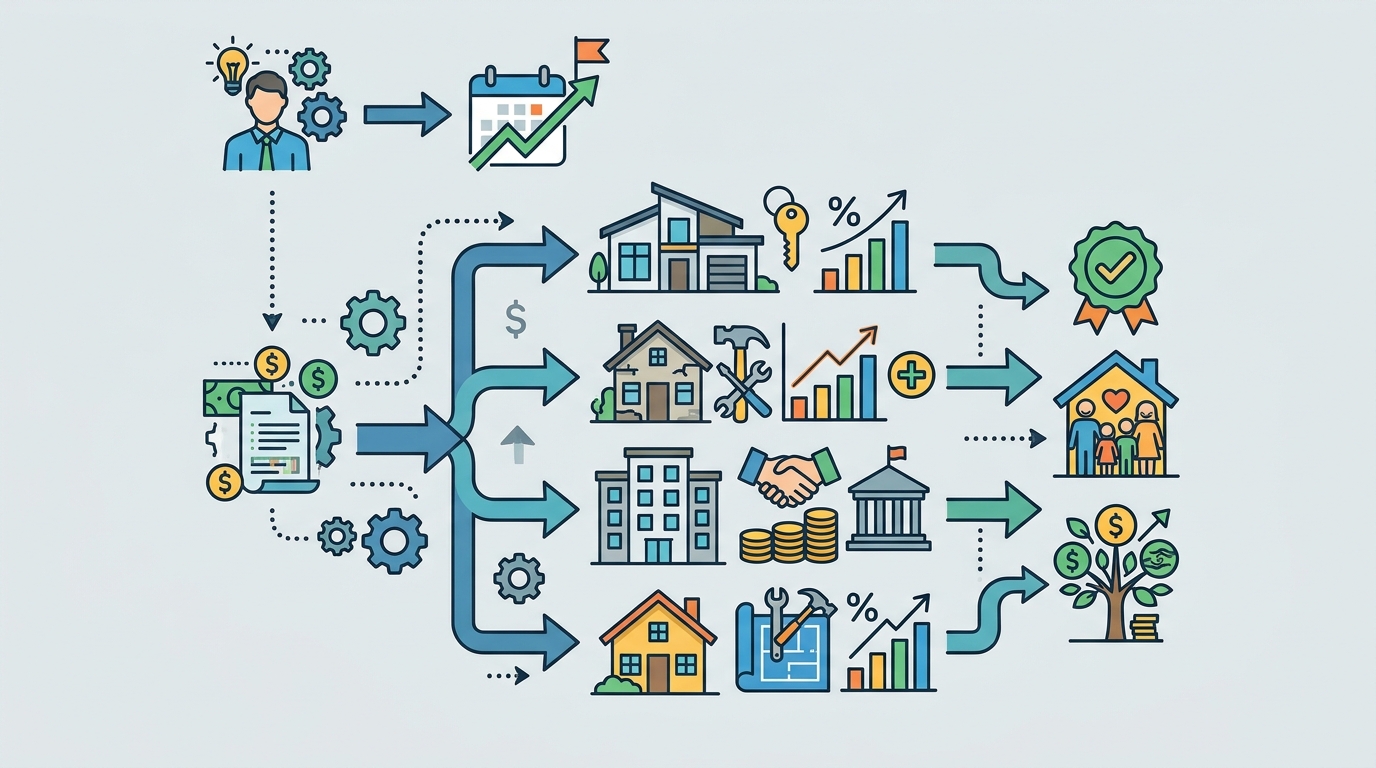
Planning for Home Loan in 2026?? Explore These Loan Options First
Before you compare lenders, it helps to understand how any lender decides. US mortgage underwriting looks at two things: you — credit history, verified income, existing obligations and available cash — and the property, its value, condition and intended use. This guide walks through the main loan options and the checks worth working through before you apply.
9 min read

Where To Check Today's Credit Card Relief Terms For Seniors
Today's terms sit in three places: the rewards program terms page on your issuer's website, the cardholder agreement attached to your specific account, and any hardship or relief terms the issuer publishes separately. The CFPB's 2024 report points consumers to issuer rewards program terms pages — such as Citi ThankYou Rewards, the Chase Ultimate Rewards Program Agreement, and Wells Fargo Rewards Terms and Conditions — as the place to check current forfeiture and account-closure rules (Consumer Financial Protection Bureau, 2024-05).
8 min read
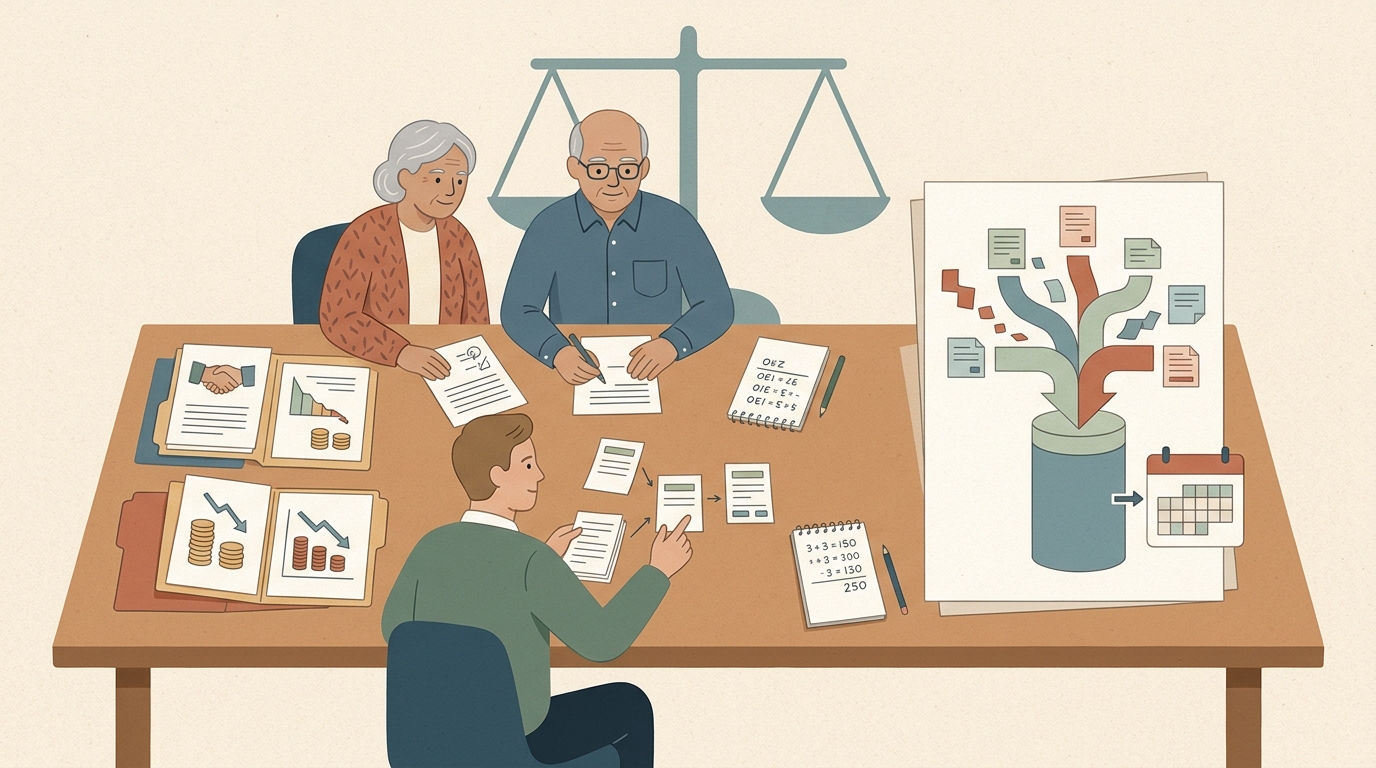
Debt Settlement Vs Consolidation For Seniors: What To Know In 2026
Debt settlement tries to get a creditor to accept less than the full balance; consolidation rolls several balances into one loan or one monthly payment without reducing what you owe. On a fixed retirement income the difference matters, because settlement usually involves stopping payments and damaging your credit, while consolidation depends on qualifying for terms better than what you already have.
9 min read

Nonprofit Credit Counseling For Seniors: How It Works In 2026
Nonprofit credit counseling is a one-on-one service: a certified counselor reviews your income, bills and debts and explains your options. The Consumer Financial Protection Bureau describes these organizations as usually nonprofit, with counselors "certified and trained in the areas of consumer credit, money and debt management, and budgeting," and says an initial session typically lasts an hour with follow-up sessions offered (Consumer Financial Protection Bureau, undated). The usual outcome is either a budget and referrals, or a debt management plan — one monthly payment to the agency, which then pays each creditor (Consumer Financial Protection Bureau, undated).
9 min read

Credit Card Debt Assistance Options For Seniors In The United States
There is no government-backed or age-specific credit card relief program created for seniors; older adults have access to the same debt relief strategies as other consumers (CBS News, undated). In practice that means nonprofit credit counseling and a debt management plan, negotiating directly with your card issuer, for-profit debt settlement, or bankruptcy.
8 min read

How to Apply for a Credit Card Hardship Plan at Chase or Capital One in 2026
Neither Chase nor Capital One publishes a hardship application form. You start by phoning the servicing line — the number on the back of your Chase card, or 1-800-CAPITAL for Capital One accounts (DebtWave, undated) — and asking for the financial hardship or payment assistance team (SoloSuit, undated). Neither issuer publishes one universal plan with identical terms for every cardholder (DebtWave, undated), so terms are decided case by case after that call.
7 min read
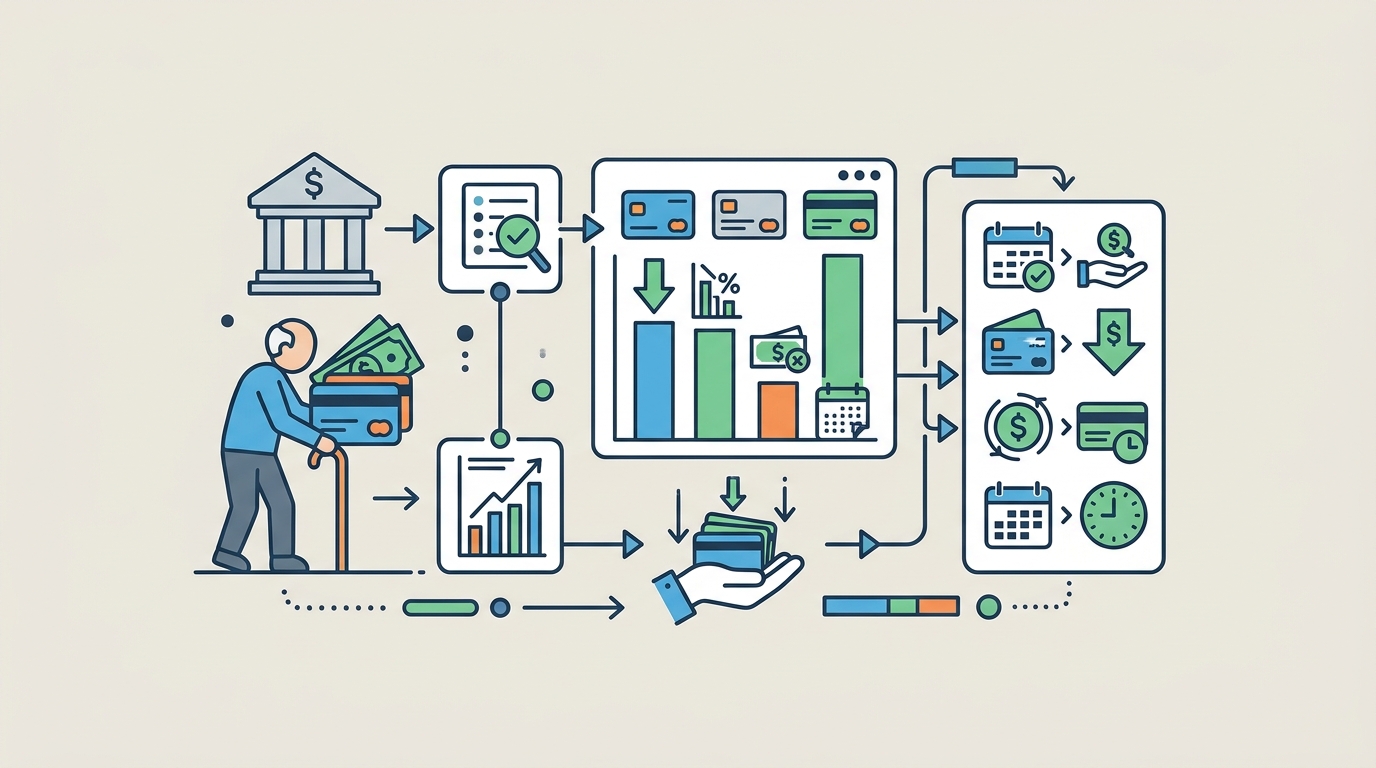
Credit Card Hardship Programs for Seniors: What Banks Offer in 2026
A credit card hardship program is a payment plan negotiated with your issuer that may temporarily lower interest and waive fees when a difficult circumstance makes paying hard (NerdWallet, undated). For seniors on a fixed income in 2026, the question is less which bank is most generous than which accommodation matches the problem — a short cash crunch, a permanently smaller monthly budget, or a balance growing faster than you can pay it down.
8 min read
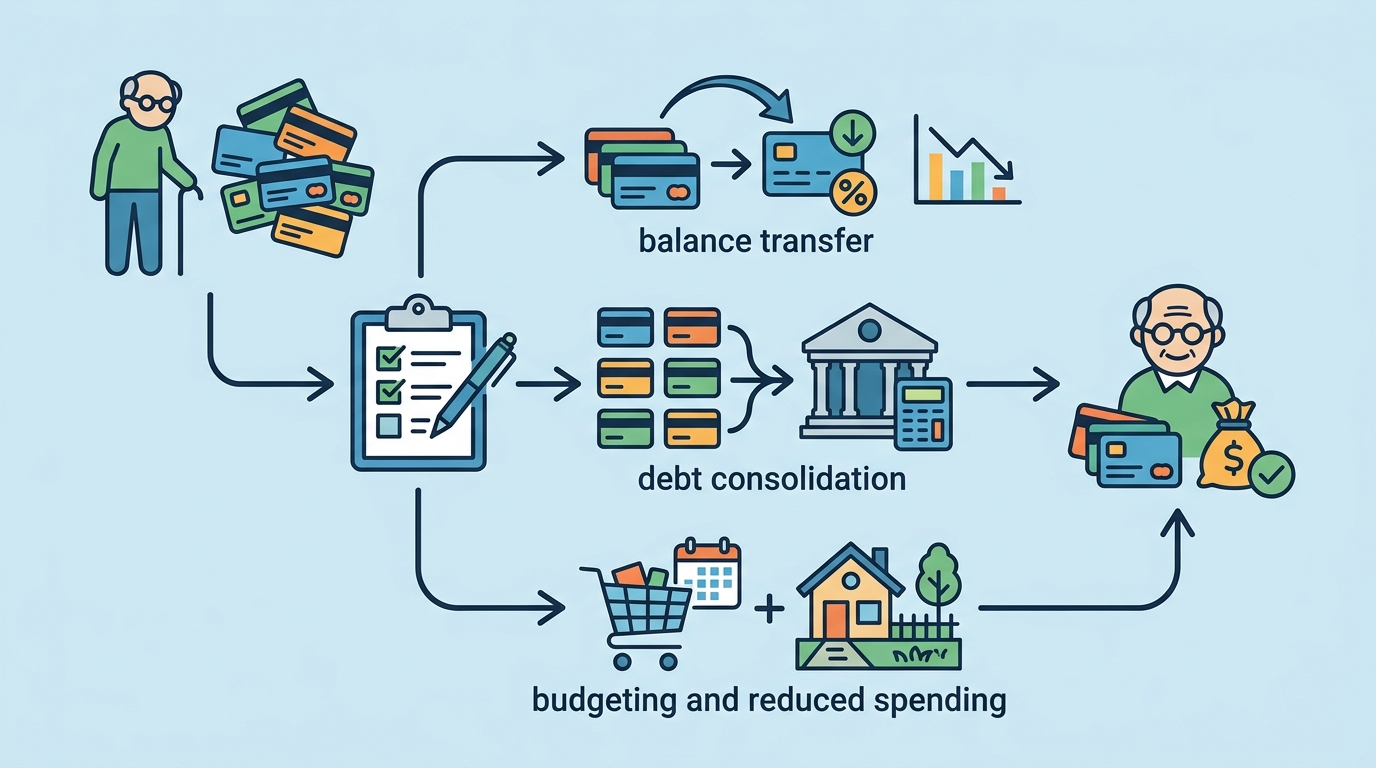
Lowering Credit Card Payments on a Fixed Income: Options for Seniors in 2026
If your credit card payment no longer fits a Social Security or pension check, the main routes are an issuer hardship program, a nonprofit credit counseling debt management plan, or direct negotiation with the card company. Each lowers the monthly payment in a different way, and none of them erase what you owe — credit counselors work to lower the overall monthly payment, often by lengthening the repayment period or getting the creditor to lower interest rates (Consumer Financial Protection Bureau, 2024-05-15).
7 min read
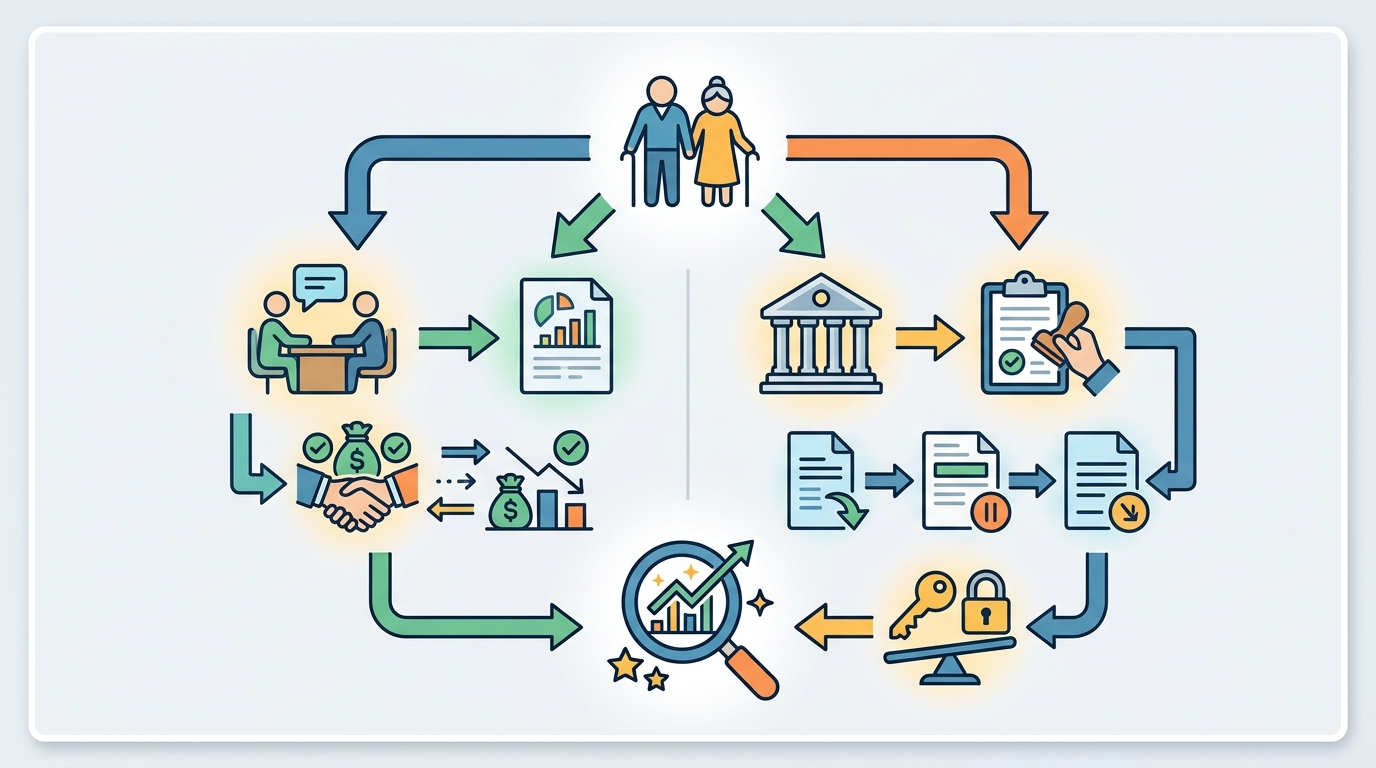
Credit Counseling vs Bank Hardship Plans for Seniors: Which to Try First in 2026
If credit card payments have outgrown a fixed income, you usually have two realistic starting points: a hardship arrangement from the card issuer itself, or a session with a nonprofit credit counseling agency that may lead to a debt management plan. Which to try first depends on how many cards are involved, whether the squeeze is temporary or ongoing, and how much structure you want around repayment.
8 min read

Medical Debt Relief Programs For Seniors: Where To Check Eligibility In 2026
If you are a senior facing medical bills in 2026, the first place to check eligibility is not a lender. It is the hospital's own written financial assistance policy, which tax-exempt hospitals must maintain under Section 501(r)(4) (Internal Revenue Service, undated), and your state, which decides whether you qualify for a Medicare Savings Program (Medicare.gov (CMS), 2026). Both can reduce what you owe without borrowing.
9 min read

Social Security Overpayment Notices: How Seniors Can Respond In 2026
If Social Security says it paid you more than you were due, the notice is the starting point, not the final word. You can ask SSA to reconsider the decision or the amount, ask it to waive collection, or ask for a lower monthly recovery rate — and SSA says it does not pursue recovery while an initial appeal or waiver request is pending (Social Security Administration, 2025-03-07) [4].
9 min read
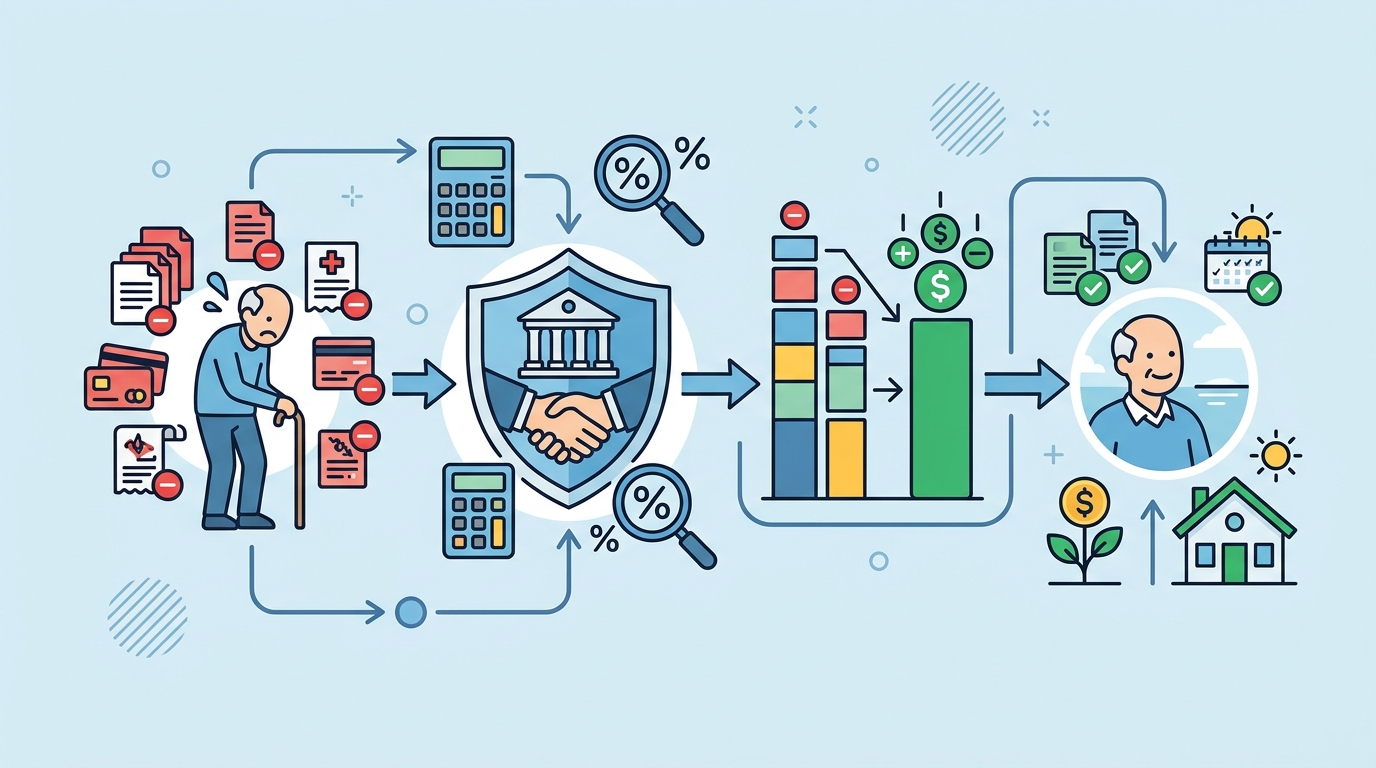
Government Debt Help For Seniors In 2026: What Options Exist
There is no government-backed or age-specific credit card debt relief program created specifically for seniors (CBS News, undated), and you won't find a general government-sponsored program that wipes out credit card balances, medical bills or other unpaid consumer debt (National Council on Aging, undated). What does exist is the ordinary set of options open to people of any age — a hardship arrangement with the creditor, a debt management plan through a credit counseling agency, a consolidation loan, a balance transfer card, or bankruptcy — plus free federal consumer-education and complaint tools.
9 min read

Credit Counseling For Seniors In 2026: How To Find A Trusted Agency
Credit counseling for seniors means sitting down with a counselor — usually at a nonprofit agency — to review income, debts and options, which may include a debt management plan or a consolidation loan. A trusted agency tells you its fees up front and will send free information about its services without requiring details about your situation; the Consumer Financial Protection Bureau says treat refusal to do that as a red flag (Consumer Financial Protection Bureau, undated). Start with the two main trade associations and the Justice Department's approved list, then verify each name with your state attorney general.
9 min read
Looking for debt relief grants as a disabled veteran? Explore potential assistance options
True "debt relief grants" — free money that clears consumer debt — are rare. Most help aimed at disabled veterans comes instead through benefit programs, hardship or waiver processes for debts owed to an agency, charitable assistance, or borrowing tools like a consolidation loan. This guide covers the borrowing side: what consolidation does, how an application works, and what to check first.
6 min read
Medical Debt Relief Options For Veterans In 2026: Where To Start
If part of your medical debt is a VA copay bill, start there before you borrow. VA offers repayment plans, compromise offers, waivers and hardship copay exemptions (U.S. Department of Veterans Affairs, 2026-09-08), and its collection clock moves fast — interest and a monthly fee after 30 days unpaid, and benefit offset possible after 90 days (U.S. Department of Veterans Affairs, 2026-07-30).
7 min read

VA Debt Relief Programs In 2026: What Disabled Veterans Should Know
If you owe money because VA overpaid a benefit, or because a health care copay bill went unpaid, that debt is owed to VA and follows VA's own routes: a repayment plan, a compromise offer (a lower amount accepted as payment in full), a waiver, or a hardship suspension (U.S. Department of Veterans Affairs, 2026-09-08).
7 min read

State Assistance Programs For Disabled Veterans In 2026: How To Check Eligibility
Most state assistance programs for disabled veterans are run by your own state's veterans affairs agency, and eligibility usually starts with the two things the VA itself looks at: a discharge under conditions other than dishonorable, and a service-connected disability rating. Eligibility for most federal and state veterans benefits is based on discharge under other than dishonorable conditions, with policy set by the U.S. Department of Veterans Affairs (Virginia Department of Veterans Services). The National Association of State Directors of Veterans Affairs keeps a public list of the current State Director for every state and territory (NASDVA).
7 min read

Credit Union Debt Consolidation Loans In 2026: What To Check Before Signing
A credit union debt consolidation loan is one loan used to pay off several debts, so you make a single payment instead of many. Credit unions are one of several places that offer these loans, alongside banks and other lenders (Consumer Financial Protection Bureau, 2024-05-15). The terms you are offered depend on the credit union, your credit profile and your state.
7 min read
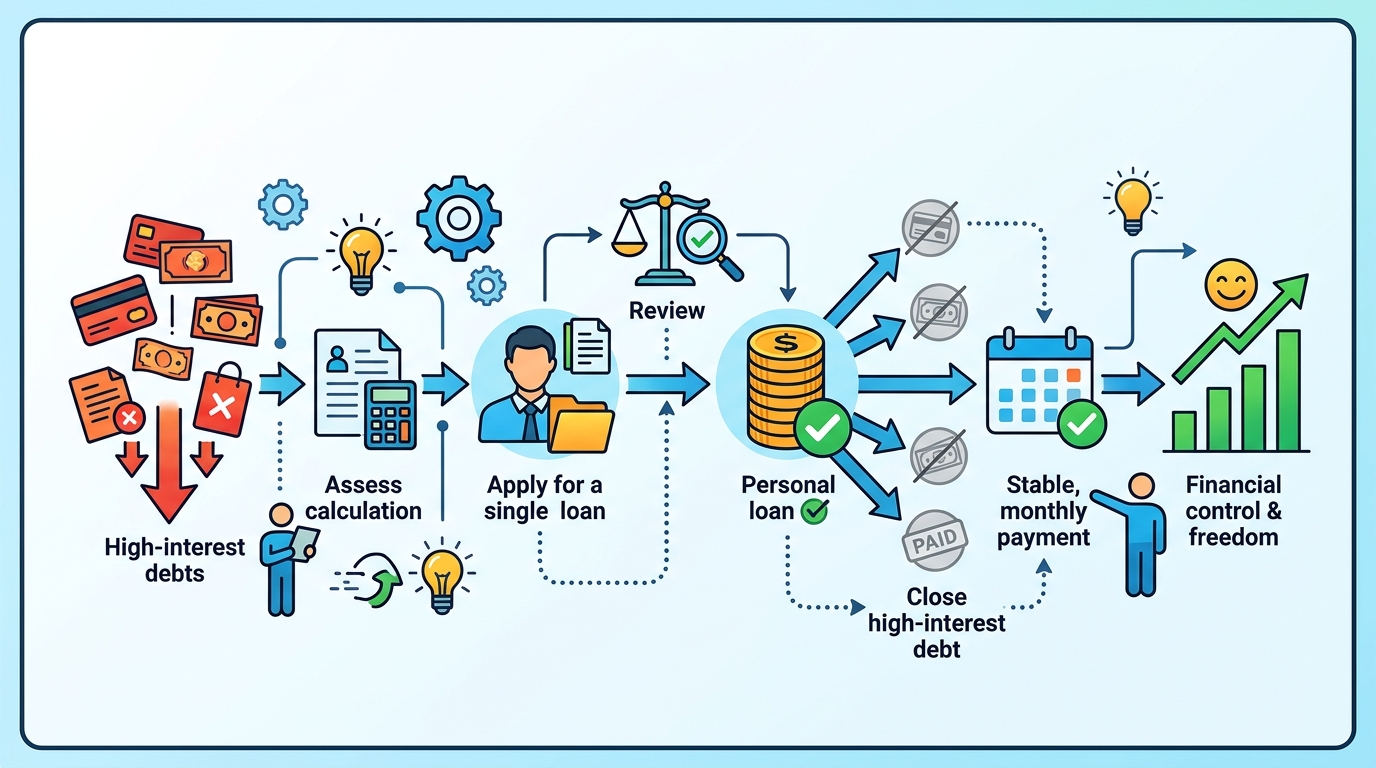
Personal Loans For Debt Consolidation In 2026: How They Work Before You Apply
A personal loan for debt consolidation replaces several balances with one new loan and one monthly payment. Banks, credit unions, and installment loan lenders all offer these loans, and they may carry a lower rate than you pay now — but the rate you are actually offered depends on your credit, income, and the lender (Consumer Financial Protection Bureau, 2026-09-02).
6 min read

Debt Consolidation Options That Let You Keep Your Credit Cards Open In 2026
You can consolidate credit card balances without closing the cards. Balance transfers, consolidation loans and home equity borrowing all move a balance somewhere new, and none of them cancels the old account by itself — though some lenders ask you to close it as a condition of funding.
7 min read

Balance Transfer Cards In 2026: Consolidate Debt Without Closing Accounts
A balance transfer card moves existing card balances onto one new account so you make a single payment, usually at a promotional rate that lasts only a limited time (Consumer Financial Protection Bureau, 2026-09-02). It does not erase what you owe. Applying does not require closing the cards you transfer from — and closing them can raise your credit utilisation and lower your score (Consumer Financial Protection Bureau, 2024-12-31).
7 min read

Personal Loans For Self-Employed Americans With Bad Credit In 2026
Being self-employed does not rule you out of a personal loan, but it changes what you have to prove. Self-employed applicants typically need more documentation than W-2 employees — tax returns, bank statements and profit-and-loss statements — because no employer vouches for the deposits (1st Franklin Financial Corporation). With weak credit on top of that, the paperwork is the part you control.
7 min read

What Documents Self-Employed Borrowers Need For A 2026 Personal Loan
If you work for yourself, a 2026 personal loan application will usually ask you to prove income with tax returns, business bank statements and often a profit-and-loss statement, rather than the pay stubs a salaried applicant hands over. You will also need the identity and address proof everyone provides — a Social Security number, a photo ID and something showing where you live (Achieve, undated).
8 min read

Personal loan options for self-employed Americans are waiting for you
Self-employed Americans can apply for the same personal loans as salaried employees — the difference is how you prove you can repay. A salaried applicant hands over pay stubs and an employer's confirmation; a contractor, sole proprietor or gig worker is usually asked for tax returns, 1099s and bank statements instead.
8 min read

How Freelancers Prove Income To Qualify For A Loan In 2026
Freelancers prove income the same way anyone does — by showing a lender where the money comes from and that it keeps coming. The difference is the paperwork: instead of employer pay stubs, you are usually asked for tax returns, 1099 forms, a profit-and-loss statement and business bank statements whose deposits match what you reported (Upstart, undated; Mariner Finance, undated).
8 min read

Should You Take This Debt Consolidation Loan Offer at 18% APR?
An 18% APR consolidation offer is neither automatically good nor automatically bad — it depends on what you are replacing, what fee is buried in the disbursement, and what a second lender would quote you on the same balance. This guide walks one consistent example — $20,000 borrowed over 60 months at 18% APR — through the disclosure boxes, a side-by-side comparison, and the break-even point where a cheaper rate with an origination fee still beats a higher rate with none.
Tobias Lindqvist · 9 min read

The Required Minimum Distribution Rule Retirees Need to Know
A required minimum distribution (RMD) is the amount the IRS makes you pull out of your pretax retirement savings each year once you hit a set age. For most people saving now, that age is 73 (Internal Revenue Service, 2024-12-10). Miss the withdrawal and the shortfall can face a 25% excise tax, cut to 10% if you fix it within two years (Internal Revenue Service, 2024-12-10).
Priya Chandrasekaran · 8 min read

What Is Loan Capitalization and How Does It Affect Your Student Loan?
Capitalization is "the addition of unpaid interest to the principal balance" of a Direct Loan Program or FFEL Program loan, and it never happens on Perkins Loans (Federal Student Aid (U.S. Department of Education), undated). After it happens, you pay interest on that former interest for the rest of the term.
Desmond Okafor · 7 min read

Backdoor Roth vs. Mega Backdoor Roth: Which Strategy Fits Your Situation
Both strategies put after-tax dollars into a Roth account when your income is too high to contribute to a Roth IRA directly. The backdoor Roth runs through a traditional IRA you open yourself. The mega backdoor Roth runs through after-tax contributions inside your employer's 401(k), and only works if the plan document allows it.
Priya Chandrasekaran · 8 min read

Traditional IRA vs. Roth IRA: Which Is Right for You
A Traditional IRA and a Roth IRA hold the same investments and share the same annual dollar cap, but they tax you at opposite ends: one may cut your taxable income this year, the other never does. Which one fits turns on four specific things — your modified adjusted gross income, your filing status, whether you or your spouse is covered by a retirement plan at work, and whether you expect your taxable income in retirement to be higher or lower than it is now.
Tobias Lindqvist · 9 min read

Schedule C vs. Schedule E: What Actually Changes Your Bill
Schedule C and Schedule E are both "income from property or business you own," but they hit your bill through different machinery. Schedule C routes net profit to self-employment tax; Schedule E routes rental losses through the passive activity rules, where a $25,000 allowance shrinks as your income rises. The same building, classified two ways, can produce two different balances due.
Renata Ibarra · 8 min read

How to Switch From a Big Bank to a Credit Union Without Losing a Payment
Moving your everyday money to a credit union is mostly a sequencing problem. The new share draft (checking) account can be open in a single visit, but the direct deposit, the autopays and the subscriptions billed to your debit card each take their own number of days to redirect — so the old account has to stay open and funded while they catch up.
Priya Chandrasekaran · 8 min read

How to Close an Old Credit Card Without Losing Your Rewards
Closing a credit card you no longer use is a short administrative task, but the rewards balance sitting on it can disappear the moment the account is marked closed. Most programs treat points as the issuer's property, not yours, and some wipe them instantly.
Renata Ibarra · 8 min read

Understanding Actual Cash Value on Your Homeowners Policy
Actual cash value (ACV) is a way of settling a claim, not a separate coverage. It pays what the damaged property was worth the moment it was destroyed — replacement cost minus depreciation for age and wear — then subtracts your deductible. On a roof or a ten-year-old sofa, that gap can be most of the bill.
Priya Chandrasekaran · 9 min read

Secured Card or Unsecured Starter Card: Comparing the Real Cost
A secured card asks you for money up front and gives you a credit line roughly equal to it. An unsecured starter card asks for nothing up front but prices the risk somewhere else — usually in the APR, sometimes in an annual fee. The deposit is refundable. The fee and the interest are not, so that is where the real cost sits.
Priya Chandrasekaran · 8 min read

Should You Choose a Roth 401(k) or a Traditional 401(k)
A Roth 401(k) and a traditional 401(k) usually sit inside the same employer plan, share the same annual IRS deferral limit, and can hold the same investments. The difference is timing: Roth contributions are after-tax going in and can come out tax-free if you meet the rules, while traditional contributions are pretax going in and every dollar out is ordinary income.
Marisol Ferreira · 9 min read

Best Bank Account for Avoiding Monthly Fees
Most checking accounts with a monthly maintenance fee will drop it if you hit a specific trigger — a minimum daily balance, a qualifying direct deposit, or a set number of debit transactions. Accounts built without a maintenance fee skip that test entirely, usually by trading away branch access or a wide fee-free ATM network. The choice is less about which is cheaper on paper and more about whether your balance and paycheck are steady enough to clear a waiver every single statement cycle.
Priya Chandrasekaran · 9 min read

Term Life vs. Whole Life Insurance Compared
Term life and whole life both pay a beneficiary when you die. The difference is how long the promise lasts, what happens to your money while you are alive, and what you pay each month. Term insurance pays a death benefit only if the insured dies during the term and generally builds no cash value; permanent insurance such as whole life pairs the death benefit with a cash-value element (National Association of Insurance Commissioners, undated).
Priya Chandrasekaran · 8 min read

Amortization, Explained With Real Numbers
Amortization is the arithmetic that decides how much of each payment kills debt and how much just rents money. On a fixed installment loan, the payment amount never changes, but the split inside it moves every month — more interest early, more principal later (Consumer Financial Protection Bureau, 2024-09-24).
Renata Ibarra · 7 min read

Your Balance Transfer Card's 0% Intro Offer: What the Fine Print Actually Means
A 0% balance transfer offer is not free money. It is a fixed up-front fee in exchange for a set number of interest-free months on one specific balance — and nothing else on the account. Balance transfer cards typically advertise 0% intro APR for 12 to 21 months and charge a 3%-5% transfer fee (PrimeRates, 2026).
Priya Chandrasekaran · 9 min read

Is a Retail Store Card's Welcome Discount Actually a Good Deal?
A store card's welcome discount is real money off today. What decides whether you keep it is what happens on the next few statements, because private label cards are priced near the top of the credit card market — the average purchase APR on cards from the largest U.S. retailers was 32.66% in December 2024 (Consumer Financial Protection Bureau, 2024-12).
Marisol Ferreira · 7 min read

The Inherited IRA 10-Year Rule, Explained
If you inherited an IRA from someone who died after 2019, you are probably on a clock. The 10-year rule says the entire balance has to be out of the account by December 31 of the year containing the 10th anniversary of the owner's death (Internal Revenue Service, 2025). Whether you also owe a withdrawal in each of the nine years before that depends on when the owner died relative to their required beginning date and on what kind of beneficiary you are.
Renata Ibarra · 9 min read

How to Do a Backdoor Roth IRA Conversion Without Triggering the Pro-Rata Rule
A backdoor Roth IRA is two separate transactions: a nondeductible (after-tax) contribution to a traditional IRA, then a conversion of that money to a Roth IRA. There is no income limit on either step, which is why the route exists for people earning above the direct Roth contribution thresholds (National Tax Tools, undated). The catch is the pro-rata rule: under IRC §408(d)(2), all your traditional, SEP and SIMPLE IRAs are treated as one contract when the taxable share of any conversion is figured (Tax Training Academy quoting IRC §408(d)(2), undated).
Renata Ibarra · 9 min read

What Happens After You File a Car Insurance Claim
Filing is the easy part. What follows is a sequence of regulated steps: an acknowledgement, an investigation, a written acceptance or denial that must name the policy language it relies on, and a payment deadline. Each of those steps runs on a clock set by your state's insurance code, not by the adjuster's schedule.
Renata Ibarra · 8 min read

What Is Credit Utilization? What It Means for Your Wallet
Credit utilization is the share of your revolving credit limits you're using when your card issuer reports your balance to the credit bureaus. It sits inside the biggest scoring category after payment history in both the FICO and VantageScore 3.0 models, and it moves every month without you applying for anything.
Renata Ibarra · 6 min read

Wage Garnishment Notice: What You Must Do and By When
A wage garnishment notice is a dated document with a countable deadline on it. For federal student loans, the Department of Education mails a written notice at least 30 days before garnishment proceedings begin, and a hearing request counts as timely only if it is postmarked or received by the designated office by the 30th day following the notice date (Office of the Federal Register / Department of Education). For a credit card or other unsecured consumer debt, garnishment generally requires a court order that results from a judgment, though certain debts owed to the government can be garnished without one (Consumer Financial Protection Bureau).
Marisol Ferreira · 9 min read

Authorized User or Joint Account: Which Is Right for Building Credit
Being added to someone else's credit card is one of the most common ways a credit file gets started. The Consumer Financial Protection Bureau found that about 1 in 4 consumers first acquire a credit history from an account they are not solely responsible for — roughly 15 percent through a co-borrower and 9.6 percent as an authorized user (Consumer Financial Protection Bureau, 2017-06).
Tobias Lindqvist · 9 min read

HO-3 vs. HO-5 Homeowners Insurance Compared
HO-3 and HO-5 are both standard homeowners forms, and they treat the building itself identically. The difference sits in one place: personal property. An HO-3 covers your belongings only against perils named in the policy, while an HO-5 covers them against everything except what the policy excludes (Policygenius, undated). An HO-3 also pays for those belongings at depreciated actual cash value unless you buy an endorsement, where an HO-5 pays replacement cost by default (Insure.com, undated).
Tobias Lindqvist · 7 min read

Should You Choose a Credit Union or a Traditional Bank Account?
The choice between a credit union and a traditional bank is not a safety question — federally insured deposits are protected to the same $250,000 standard limit on both sides. It is a question of what you pay each month, what happens when you overdraw, how far your ATM access reaches, and whether you can even join.
Desmond Okafor · 10 min read

Why Your Bank Charges a Monthly Maintenance Fee
A monthly maintenance fee is a flat charge taken from your checking, savings or money market account each statement cycle, simply for having the account. It is disclosed before you open, it can be waived on conditions the bank sets, and it is separate from overdraft or ATM charges.
Marisol Ferreira · 6 min read

Checking vs. Savings: Which Account Fits Your Spending Habits
Checking and savings are both deposit accounts with the same federal insurance behind them, but they are priced and restricted for opposite jobs. Checking is built for payments going out: a debit card, bill pay, ATM withdrawals, usually little or no interest. Savings is built for a balance that stays put: an interest rate, fewer ways to spend from it, and sometimes a bank-imposed cap on transfers out.
Marisol Ferreira · 9 min read

Married Filing Jointly vs. Married Filing Separately: What Actually Changes Your Bill
Married couples get two choices on the top of Form 1040, U.S. Individual Income Tax Return: married filing jointly or married filing separately. The brackets and standard deductions for separate filers are set at roughly half the joint figures, so for most couples the split itself is tax-neutral. What actually changes the bill is the list of deductions and credits that separate filers lose, the halved limits on things like capital losses, and the surtax thresholds that kick in at half the joint level.
Priya Chandrasekaran · 10 min read

401(k) Contribution Limits, Explained
A 401(k) has more than one limit, and they come from different places. The IRS caps how much of your own pay you can defer each year. A separate IRS cap covers everything that lands in your account, including the employer match. Your employer's plan document then decides which of those options it actually offers you.
Marisol Ferreira · 8 min read

What Is Form 4868 and When Is It Due
Form 4868 buys you six more months to file your individual income tax return. It does not buy you six more months to pay. That single distinction drives almost every penalty readers run into after filing one.
Tobias Lindqvist · 7 min read

How to Convert a Traditional IRA to a Roth IRA Without a Tax Surprise
Converting a traditional IRA to a Roth IRA moves pretax money into an account where future qualified withdrawals come out tax-free and no required minimum distributions apply (Internal Revenue Service, 2025-11-16). The price is that the untaxed amount is added to your income for the year of the conversion and reported on Form 8606 (Internal Revenue Service, 2025-11-16). Most of the damage people do to themselves is procedural, not strategic: cash leaking out in withholding, a missed 60-day window, or converting money that was never eligible.
Marisol Ferreira · 10 min read

You Got a Collections Notice From a Debt Buyer — Here's What to Do
A collections letter from a company you have never borrowed from usually means your account was charged off and sold. The letter is a validation notice, and it starts a 30-day clock: dispute the debt in writing inside that window and the collector has to stop collecting until it mails you verification (Consumer Financial Protection Bureau, 2012-10).
Renata Ibarra · 10 min read

Form 1099-NEC: What It Reports and Who Has to File It
Form 1099-NEC, Nonemployee Compensation, is the information return a business files when it pays someone who is not an employee $600 or more for services during the year (Internal Revenue Service, 2024-01). The IRS copy and the recipient copy are both due January 31 — February 2, 2026 for 2025 payments, because January 31, 2026 falls on a weekend (Internal Revenue Service, 2025).
Desmond Okafor · 7 min read

Notice of Default on Your Car Loan: What You Must Do Before Repossession
A notice of default on a car loan is not the same document as a notice of repossession, and the gap between them is often measured in days. Auto loans are secured installment debt: the car is the collateral, and in many states the lender does not need a court order to take it back (Federal Trade Commission, undated). What protects you is the cure window written into your state's law and your retail installment contract — and that window starts on the date printed on the notice.
Priya Chandrasekaran · 9 min read

What Is Loss of Use Coverage and Do You Need It?
Loss of use coverage — printed on most policies as Coverage D or Additional Living Expenses (ALE) — is the part of a homeowners or renters policy that pays for a motel, a short-term rental and other added costs when a covered loss makes your home unfit to live in. It is a standard part of homeowners insurance (Farmers Insurance (citing Insurance Information Institute), undated), so for most people the question is not whether to add it but whether the built-in cap is big enough and lasts long enough.
Renata Ibarra · 9 min read

How to File a Life Insurance Claim, Step by Step
Filing a life insurance claim is mostly a documents exercise. The insurer has to confirm three things: that the person died, that the policy was in force on that date, and that you are the beneficiary named on it. Everything you send is in service of one of those three questions, and the claim moves at the speed of the slowest missing document.
Marisol Ferreira · 9 min read

How to File a Water Damage Claim, Step by Step
A water damage claim is won or lost in the first week. Insurers decide these claims on two questions: was the water sudden and accidental, and can you prove it. Everything you gather before the adjuster arrives goes to those two points.
Desmond Okafor · 9 min read

What a Variable APR Actually Costs You Over Time
A variable APR is not one rate. It is a benchmark index that moves on its own schedule plus a fixed margin your issuer sets, and the cardholder agreement spells out exactly how the two combine (Consumer Financial Protection Bureau, undated). When the index moves, your interest charge moves with it — on the balance you already owe, often with no advance letter.
Desmond Okafor · 6 min read

What to Do If Your Debit Card Is Declined but You Have Money
A debit card declines when the money is not available, not when it is not there. The gap usually comes from a deposit hold, a merchant pre-authorization that has not released, or a transfer that has not finished posting — and each one has a schedule you can ask about by name.
Renata Ibarra · 8 min read

IRS Letter 5071C: What It Means and How to Respond
Letter 5071C is sent when an IRS filter flags a federal income tax return filed under your name, Social Security number or ITIN as possibly filed by someone else. It asks you to confirm you are the person who filed it. It does not say you owe money, and it does not mean your return was audited.
Marisol Ferreira · 8 min read

Should You Switch From a No-Fee Card to a Rewards Card?
Switching from a no-fee card to a rewards card is a bet that what you earn will clear what you pay. There are only three inputs: the annual fee, your yearly spend times the rewards rate, and whatever interest you pay if a balance rolls over. Run those three numbers and the decision usually answers itself.
Renata Ibarra · 9 min read

Filing a Claim for a Fallen Tree: What to Do First
A tree on your roof is a property damage claim, a debris removal claim and, sometimes, a dispute with a neighbor's insurer — and the three are paid under different parts of the policy with different limits. What you do in the first day, before the chainsaws arrive, decides how much of it gets paid.
Tobias Lindqvist · 9 min read

Short-Term Disability vs. Long-Term Disability Insurance Compared
Short-term and long-term disability insurance are not competing products so much as two halves of a timeline. Short-term disability (STD) typically replaces 40% to 70% of salary for three to six months (U.S. Chamber of Commerce, undated). Long-term disability (LTD) typically pays about 60% of gross monthly income, but only after a waiting period of 30 to 180 days, with 90 days common (U.S. Chamber of Commerce, undated).
Renata Ibarra · 8 min read

Dormant Account Fee, Explained: What It Costs and When It Applies
A dormant account fee is a recurring charge for leaving a checking or savings account untouched. Two separate clocks matter: the bank's own inactivity clock, which can start as early as 60 days in some deposit contracts, and your state's unclaimed-property clock, which usually runs three to five years before the balance is turned over to the state.
Desmond Okafor · 7 min read

Overdraft Fee, Explained: What It Costs and When It Applies
An overdraft fee is what a bank or credit union charges when it pays a transaction that drops your checking balance below zero. The median fee at institutions holding more than $10 billion in assets was $35 (Consumer Financial Protection Bureau, 2023-12), and most very large institutions still charge $35 per overdraft transaction (Consumer Financial Protection Bureau, 2024-12).
Tobias Lindqvist · 6 min read

The April Deadline for Filing Your Tax Return: What You Need to Know
Your federal income tax return for the 2025 tax year is due April 15, 2026 (Internal Revenue Service, 2026-05). That single date carries two obligations: filing the return and paying anything you owe. Form 4868 can move the first one; nothing moves the second.
Renata Ibarra · 9 min read

Standard Deduction vs. Itemized Deductions: Which One Saves You More
Every return makes you pick one of two ways to reduce taxable income: a flat standard deduction set by filing status, or the sum of specific expenses listed on Schedule A (Form 1040), Itemized Deductions. The Internal Revenue Service's own rule is simple — itemize if your allowable itemized deductions add up to more than your standard deduction, or if a rule forces you to itemize (Internal Revenue Service, undated).
Marisol Ferreira · 9 min read

Is 7% a Good Rate for an Auto Refinance Loan Right Now?
A 7% APR auto refinance offer sits just under the recent market average: LendingTree's marketplace data put the average auto refinance rate at 7.76% across all credit scores in Q4 2025, and at 7.85% in February 2026 versus 7.97% in February 2025 (LendingTree, 2026-06). So 7% is not a bad number in isolation. Whether it is a good number for you depends on what you are paying now, how many months are left, and what the refinance costs to close.
Marisol Ferreira · 9 min read

What Is a Check Hold, and How Does It Work?
A check hold is the gap between the moment a bank credits a deposit to your balance and the moment you can actually spend it. Federal rules under Regulation CC set outside limits on that gap: most local check deposits into a checking account must be available no later than the second business day after the day of deposit (FDIC, 2024-03), with a smaller slice available the next business day.
Priya Chandrasekaran · 6 min read

How Forbearance Actually Works on a Student Loan
Forbearance is a temporary postponement or reduction of student loan payments, generally granted because you are having financial difficulty (Consumer Financial Protection Bureau, undated). It stops the payment due, not the interest. On every loan type, interest keeps accruing daily during forbearance (Edfinancial Services, undated), and unpaid interest on an unsubsidized loan can be added to your principal afterwards.
Marisol Ferreira · 7 min read

What the New Roth Catch-Up Contribution Rule Means for Your 401(k)
Starting in 2026, some people who put extra money into a 401(k) after age 50 will no longer get a pretax deduction for it. Section 603 of the SECURE 2.0 Act requires that catch-up contributions by employees above a prior-year wage threshold be made as Roth (after-tax) contributions, and the IRS confirmed the January 1, 2026 start date in final regulations issued September 15, 2025 (Ed Slott and Company, 2025-09).
Desmond Okafor · 7 min read

600s Credit Score: What It Means and What to Do Next
A credit score in the 600s lands in the "Fair" band: FICO treats 580–669 as Fair (Chase, 2024-05), and VantageScore 3.0 treats 601–660 as Fair (Chase, 2024-05). Lenders generally treat a Fair FICO Score as a subprime borrower category, meaning your credit standing is less than they normally want to see (Experian, undated). About 17% of consumers sit in the FICO Fair range of 580–669, against an average FICO Score of 714 in 2022 (Experian, undated).
Tobias Lindqvist · 7 min read

How to Roll Over Leftover 529 Funds Into a Roth IRA
If a 529 plan has money left in it after school is paid for, the beneficiary may be able to move some of it into a Roth IRA in their own name instead of taking a taxable withdrawal. Section 126 of SECURE 2.0 created this option, with a lifetime maximum of $35,000 per beneficiary (Kitces.com, undated), and it applies to distributions made after December 31, 2023 (Internal Revenue Service, 2025).
Priya Chandrasekaran · 10 min read

Should You Take This Personal Loan Offer at 24% APR?
A 24% APR offer on an unsecured personal loan is not automatically a bad deal or a good one — it depends on what you are comparing it to and what the origination fee does to the cash you actually receive. This guide uses one set of numbers throughout: a $10,000 closed-end installment loan, 24% APR, 36 months, with a 5% origination fee. That works out to $392.32 a month, $14,123 repaid in total, and $9,500 in your bank account on day one.
Desmond Okafor · 9 min read

What to Do If You Get a CP2000 Notice
A CP2000 arrives when the income, credits or deductions on your filed return don't line up with the Forms W-2, 1098 and 1099 that employers, banks and brokers sent the IRS about you. It is a proposal, not a bill (Internal Revenue Service, September 2026) — but if you say nothing, the proposal becomes a formal deficiency notice with a hard court deadline attached.
Tobias Lindqvist · 9 min read

Check Hold: Why It Happens and How to Fix It
A hold means the money is in your balance but not yours to spend yet. Most of the time it is one of three things: a check deposit sitting under the Regulation CC availability schedule, a debit-card authorization a merchant has not settled or reversed, or an incoming electronic transfer that has not posted. Each has a different fix and a different person to call.
Tobias Lindqvist · 7 min read

HSA vs. 401(k): Which Account Should Get Your Next Dollar
An HSA and a 401(k) both shelter money from tax, but they are gated differently: the 401(k) needs an employer plan, and the HSA needs you to be covered by a high-deductible health plan and off Medicare. Each has its own IRS contribution cap for the year, its own penalty for taking money out early, and its own deadline that closes for good on December 31.
Desmond Okafor · 9 min read

How to Raise a Fair Credit Score Before a Mortgage Application
If your score sits in the fair range and you want a mortgage, the work splits into three jobs: get the errors off your reports, get your reported card balances down before they post, and stop adding new accounts and inquiries. Each of those runs on its own clock, and the clocks are set by regulation and by issuer billing cycles, not by how fast you act.
Desmond Okafor · 8 min read

Replacement Cost vs. Actual Cash Value: Which Do You Need?
Every property policy settles claims one of two ways. Actual cash value pays what your damaged item was worth the day it broke — replacement cost minus depreciation (Progressive, 2024-08-22). Replacement cost value pays what it costs to buy the item again, ignoring depreciation (Progressive, 2024-08-22). The gap between them is called recoverable depreciation, and on a single stolen laptop it can run $800.
Desmond Okafor · 8 min read

You Got an IRS Letter About a Balance Due -- Here's What's Next
An IRS balance-due letter is not an opening offer. It states a tax year, an amount, and a pay-by date, and the penalty and interest clocks keep running from the original return due date whether or not you reply. What changes depending on the letter is how many days you have and what the IRS can do when they run out.
Priya Chandrasekaran · 8 min read

Traditional IRA vs. Roth IRA: Which One Saves You More
A traditional IRA and a Roth IRA take the same maximum contribution in 2025 — $7,000, or $8,000 if you are age 50 or older (Internal Revenue Service, 2025). The difference is when the tax break lands: the traditional version may cut this year's taxable income, while the Roth never does, because contributions to a Roth IRA are never deductible (Internal Revenue Service, 2025).
Desmond Okafor · 10 min read

Your Bank Account Is Frozen — Here's What Comes Next
A frozen balance is rarely one thing. It is usually a Reg CC hold on a deposited check, a creditor levy or garnishment order that hit the account the moment the bank received it, or an internal fraud review that locked the card and the account together. Each has a different owner inside the bank, a different piece of required paperwork, and a different clock.
Marisol Ferreira · 8 min read

What Is a Charge-Off and How Does It Affect Your Credit Report?
A charge-off is an accounting entry your lender makes when it decides a debt is unlikely to be collected. It changes how the account is classified on the lender's books and how it reads on your credit report. It does not cancel what you owe (Leinart Law), and it does not stop collection — the original lender can keep the account or hand it to a collection agency (Debt.org).
Tobias Lindqvist · 7 min read

What to Do If You Get a CP504 Notice
A CP504 is the IRS telling you it has an unpaid balance on your account and intends to levy to collect it. The notice carries the formal Notice of Intent to Levy language under Internal Revenue Code section 6331(d), and the first thing it can take is your state income tax refund (Internal Revenue Service, 2025-12-16).
Desmond Okafor · 9 min read

How to Dispute a Charge on Your Credit Card Statement
A credit card dispute is a formal process with fixed deadlines on both sides, not a customer service favour. If you send a written billing-error notice that reaches your issuer within 60 days after the first statement containing the error was sent to you, the issuer must acknowledge it in writing within 30 days and resolve it within 90 days (Federal Trade Commission, 2022-05).
Marisol Ferreira · 8 min read

How to Apply for a New Credit Card Without Hurting Your Score
Applying for a credit card means authorising a hard inquiry, and a hard inquiry is the one part of the process you cannot undo. You can, though, control what your report looks like on the day the issuer pulls it, how many pulls you trigger, and how long you wait between them.
Priya Chandrasekaran · 7 min read

Understanding Gap Insurance on Your Auto Loan Policy
GAP is an optional add-on that covers the difference between what you owe on an auto loan and what your insurance company pays if the car is stolen or totaled (Consumer Financial Protection Bureau, 2024-03-08). It exists because standard auto insurance pays up to the value of the vehicle, not the balance of your loan (Consumer Financial Protection Bureau, 2024-03-08) — and those two numbers can be thousands of dollars apart in the first years of a long loan.
Tobias Lindqvist · 8 min read

Balance Transfer Card or Personal Loan: Comparing the Real Cost
A balance transfer card and a fixed-rate personal loan both move expensive credit card debt somewhere cheaper. They charge for it differently: the card usually takes a one-off fee up front and gives you a promotional rate for a limited window, while the loan charges interest every month for a fixed term. Which costs less depends on your balance, the monthly payment you can actually make, and whether you clear the debt before the promotional window closes.
Desmond Okafor · 8 min read

A Step-by-Step Guide to Rolling Over Your 401(k) to an IRA
Moving money from a former employer's 401(k) into an IRA is mostly paperwork, but two choices inside that paperwork decide whether the move is tax-free or expensive: who the check is payable to, and whether the pretax and designated Roth portions land in matching account types. Get those right and nothing is withheld and nothing is taxed. Get them wrong and part of the balance becomes income for that tax year.
Tobias Lindqvist · 10 min read

High-Yield Savings vs. Money Market Account: Which One Fits You
A high-yield savings account and a money market account are both federally insured deposit accounts that pay a variable rate. The difference that matters on the day you sign is access: money market accounts commonly come with checks or a debit card, while savings accounts usually do not, and the published rates on the two sit close together — a national average of 0.66% APY for savings versus 0.46% for money market accounts, with the top listed accounts paying roughly 4.00% and up to 4.05% respectively (Bankrate, 2026-10-01).
Renata Ibarra · 9 min read

What Is Umbrella Insurance and Do You Need It?
Umbrella insurance is extra liability coverage that pays only after the liability limit on an underlying policy — usually auto, homeowners or renters — has been used up. It does not replace those policies; it extends them, and insurers will not sell it to you unless your underlying limits are already high.
Marisol Ferreira · 8 min read

What Is Form 1099-K and When Is It Due
Form 1099-K, Payment Card and Third Party Network Transactions, is an information return that payment processors, apps and online marketplaces send to you and to the IRS. It reports the gross amount they settled to you during the calendar year, before refunds, chargebacks, fees or discounts come out (Britannica Money, undated). Your copy is due by January 31 (IRS, undated), and for 2025 forms the furnishing date is February 2, 2026 (IRS, 2025).
Priya Chandrasekaran · 9 min read

Missed a Student Loan Payment? Here's What Happens in the Next 90 Days
Missing a student loan payment starts a clock, and the clock runs differently depending on whether the loan is federal or private. On federal loans, late payments get reported to credit bureaus after more than 90 days past due, and default arrives at 270 days of non-payment (Federal Student Aid, U.S. Department of Education, undated). Private student loans are generally treated as in default after 120 days of non-payment (FinAid.org, undated).
Tobias Lindqvist · 9 min read