 Finance




Latest Guides

Debt Settlement Vs Consolidation For Seniors: What To Know In 2026
Debt settlement tries to get a creditor to accept less than the full balance; consolidation rolls several balances into one loan or one monthly payment without reducing what you owe. On a fixed retirement income the difference matters, because settlement usually involves stopping payments and damaging your credit, while consolidation depends on qualifying for terms better than what you already have.
9 min read

Nonprofit Credit Counseling For Seniors: How It Works In 2026
Nonprofit credit counseling is a one-on-one service: a certified counselor reviews your income, bills and debts and explains your options. The Consumer Financial Protection Bureau describes these organizations as usually nonprofit, with counselors "certified and trained in the areas of consumer credit, money and debt management, and budgeting," and says an initial session typically lasts an hour with follow-up sessions offered (Consumer Financial Protection Bureau, undated). The usual outcome is either a budget and referrals, or a debt management plan — one monthly payment to the agency, which then pays each creditor (Consumer Financial Protection Bureau, undated).
9 min read

Credit Card Debt Assistance Options For Seniors In The United States
There is no government-backed or age-specific credit card relief program created for seniors; older adults have access to the same debt relief strategies as other consumers (CBS News, undated). In practice that means nonprofit credit counseling and a debt management plan, negotiating directly with your card issuer, for-profit debt settlement, or bankruptcy.
8 min read

How to Apply for a Credit Card Hardship Plan at Chase or Capital One in 2026
Neither Chase nor Capital One publishes a hardship application form. You start by phoning the servicing line — the number on the back of your Chase card, or 1-800-CAPITAL for Capital One accounts (DebtWave, undated) — and asking for the financial hardship or payment assistance team (SoloSuit, undated). Neither issuer publishes one universal plan with identical terms for every cardholder (DebtWave, undated), so terms are decided case by case after that call.
7 min read

Credit Card Hardship Programs for Seniors: What Banks Offer in 2026
A credit card hardship program is a payment plan negotiated with your issuer that may temporarily lower interest and waive fees when a difficult circumstance makes paying hard (NerdWallet, undated). For seniors on a fixed income in 2026, the question is less which bank is most generous than which accommodation matches the problem — a short cash crunch, a permanently smaller monthly budget, or a balance growing faster than you can pay it down.
8 min read
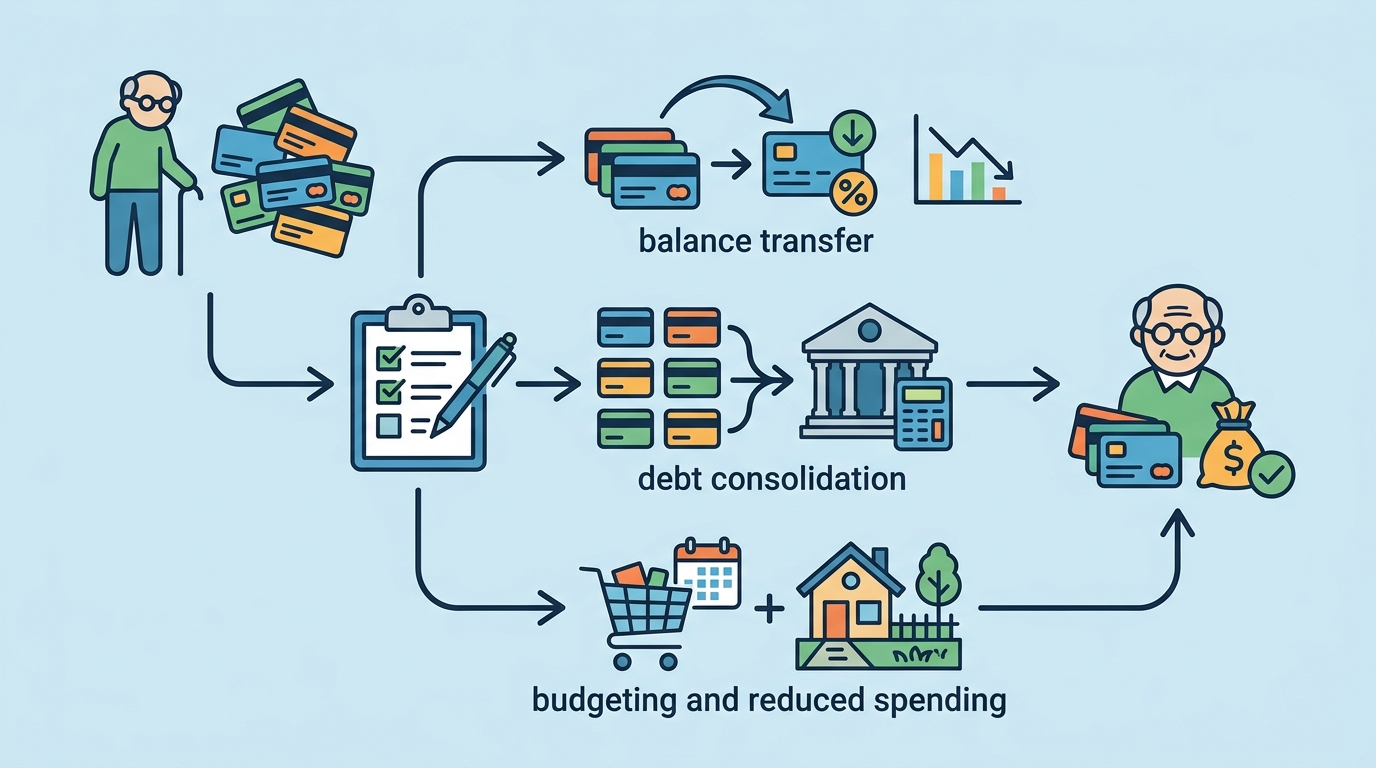
Lowering Credit Card Payments on a Fixed Income: Options for Seniors in 2026
If your credit card payment no longer fits a Social Security or pension check, the main routes are an issuer hardship program, a nonprofit credit counseling debt management plan, or direct negotiation with the card company. Each lowers the monthly payment in a different way, and none of them erase what you owe — credit counselors work to lower the overall monthly payment, often by lengthening the repayment period or getting the creditor to lower interest rates (Consumer Financial Protection Bureau, 2024-05-15).
7 min read

Credit Counseling vs Bank Hardship Plans for Seniors: Which to Try First in 2026
If credit card payments have outgrown a fixed income, you usually have two realistic starting points: a hardship arrangement from the card issuer itself, or a session with a nonprofit credit counseling agency that may lead to a debt management plan. Which to try first depends on how many cards are involved, whether the squeeze is temporary or ongoing, and how much structure you want around repayment.
8 min read

Medical Debt Relief Programs For Seniors: Where To Check Eligibility In 2026
If you are a senior facing medical bills in 2026, the first place to check eligibility is not a lender. It is the hospital's own written financial assistance policy, which tax-exempt hospitals must maintain under Section 501(r)(4) (Internal Revenue Service, undated), and your state, which decides whether you qualify for a Medicare Savings Program (Medicare.gov (CMS), 2026). Both can reduce what you owe without borrowing.
9 min read
Banking & Everyday Accounts
See all →
How to Switch From a Big Bank to a Credit Union Without Losing a Payment
Moving your everyday money to a credit union is mostly a sequencing problem. The new share draft (checking) account can be open in a single visit, but the direct deposit, the autopays and the subscriptions billed to your debit card each take their own number of days to redirect — so the old account has to stay open and funded while they catch up.
Priya Chandrasekaran · 8 min read

Best Bank Account for Avoiding Monthly Fees
Most checking accounts with a monthly maintenance fee will drop it if you hit a specific trigger — a minimum daily balance, a qualifying direct deposit, or a set number of debit transactions. Accounts built without a maintenance fee skip that test entirely, usually by trading away branch access or a wide fee-free ATM network. The choice is less about which is cheaper on paper and more about whether your balance and paycheck are steady enough to clear a waiver every single statement cycle.
Priya Chandrasekaran · 9 min read

Should You Choose a Credit Union or a Traditional Bank Account?
The choice between a credit union and a traditional bank is not a safety question — federally insured deposits are protected to the same $250,000 standard limit on both sides. It is a question of what you pay each month, what happens when you overdraw, how far your ATM access reaches, and whether you can even join.
Desmond Okafor · 10 min read

Why Your Bank Charges a Monthly Maintenance Fee
A monthly maintenance fee is a flat charge taken from your checking, savings or money market account each statement cycle, simply for having the account. It is disclosed before you open, it can be waived on conditions the bank sets, and it is separate from overdraft or ATM charges.
Marisol Ferreira · 6 min read
Credit Cards & Credit Scores
See all →
How to Close an Old Credit Card Without Losing Your Rewards
Closing a credit card you no longer use is a short administrative task, but the rewards balance sitting on it can disappear the moment the account is marked closed. Most programs treat points as the issuer's property, not yours, and some wipe them instantly.
Renata Ibarra · 8 min read

Secured Card or Unsecured Starter Card: Comparing the Real Cost
A secured card asks you for money up front and gives you a credit line roughly equal to it. An unsecured starter card asks for nothing up front but prices the risk somewhere else — usually in the APR, sometimes in an annual fee. The deposit is refundable. The fee and the interest are not, so that is where the real cost sits.
Priya Chandrasekaran · 8 min read

Is a Retail Store Card's Welcome Discount Actually a Good Deal?
A store card's welcome discount is real money off today. What decides whether you keep it is what happens on the next few statements, because private label cards are priced near the top of the credit card market — the average purchase APR on cards from the largest U.S. retailers was 32.66% in December 2024 (Consumer Financial Protection Bureau, 2024-12).
Marisol Ferreira · 7 min read

What Is Credit Utilization? What It Means for Your Wallet
Credit utilization is the share of your revolving credit limits you're using when your card issuer reports your balance to the credit bureaus. It sits inside the biggest scoring category after payment history in both the FICO and VantageScore 3.0 models, and it moves every month without you applying for anything.
Renata Ibarra · 6 min read
Loans & Debt
See all →
Should You Take This Debt Consolidation Loan Offer at 18% APR?
An 18% APR consolidation offer is neither automatically good nor automatically bad — it depends on what you are replacing, what fee is buried in the disbursement, and what a second lender would quote you on the same balance. This guide walks one consistent example — $20,000 borrowed over 60 months at 18% APR — through the disclosure boxes, a side-by-side comparison, and the break-even point where a cheaper rate with an origination fee still beats a higher rate with none.
Tobias Lindqvist · 9 min read

What Is Loan Capitalization and How Does It Affect Your Student Loan?
Capitalization is "the addition of unpaid interest to the principal balance" of a Direct Loan Program or FFEL Program loan, and it never happens on Perkins Loans (Federal Student Aid (U.S. Department of Education), undated). After it happens, you pay interest on that former interest for the rest of the term.
Desmond Okafor · 7 min read

Amortization, Explained With Real Numbers
Amortization is the arithmetic that decides how much of each payment kills debt and how much just rents money. On a fixed installment loan, the payment amount never changes, but the split inside it moves every month — more interest early, more principal later (Consumer Financial Protection Bureau, 2024-09-24).
Renata Ibarra · 7 min read

Your Balance Transfer Card's 0% Intro Offer: What the Fine Print Actually Means
A 0% balance transfer offer is not free money. It is a fixed up-front fee in exchange for a set number of interest-free months on one specific balance — and nothing else on the account. Balance transfer cards typically advertise 0% intro APR for 12 to 21 months and charge a 3%-5% transfer fee (PrimeRates, 2026).
Priya Chandrasekaran · 9 min read
Taxes
See all →
Schedule C vs. Schedule E: What Actually Changes Your Bill
Schedule C and Schedule E are both "income from property or business you own," but they hit your bill through different machinery. Schedule C routes net profit to self-employment tax; Schedule E routes rental losses through the passive activity rules, where a $25,000 allowance shrinks as your income rises. The same building, classified two ways, can produce two different balances due.
Renata Ibarra · 8 min read

Married Filing Jointly vs. Married Filing Separately: What Actually Changes Your Bill
Married couples get two choices on the top of Form 1040, U.S. Individual Income Tax Return: married filing jointly or married filing separately. The brackets and standard deductions for separate filers are set at roughly half the joint figures, so for most couples the split itself is tax-neutral. What actually changes the bill is the list of deductions and credits that separate filers lose, the halved limits on things like capital losses, and the surtax thresholds that kick in at half the joint level.
Priya Chandrasekaran · 10 min read

What Is Form 4868 and When Is It Due
Form 4868 buys you six more months to file your individual income tax return. It does not buy you six more months to pay. That single distinction drives almost every penalty readers run into after filing one.
Tobias Lindqvist · 7 min read

Form 1099-NEC: What It Reports and Who Has to File It
Form 1099-NEC, Nonemployee Compensation, is the information return a business files when it pays someone who is not an employee $600 or more for services during the year (Internal Revenue Service, 2024-01). The IRS copy and the recipient copy are both due January 31 — February 2, 2026 for 2025 payments, because January 31, 2026 falls on a weekend (Internal Revenue Service, 2025).
Desmond Okafor · 7 min read
Insurance
See all →
Understanding Actual Cash Value on Your Homeowners Policy
Actual cash value (ACV) is a way of settling a claim, not a separate coverage. It pays what the damaged property was worth the moment it was destroyed — replacement cost minus depreciation for age and wear — then subtracts your deductible. On a roof or a ten-year-old sofa, that gap can be most of the bill.
Priya Chandrasekaran · 9 min read

Term Life vs. Whole Life Insurance Compared
Term life and whole life both pay a beneficiary when you die. The difference is how long the promise lasts, what happens to your money while you are alive, and what you pay each month. Term insurance pays a death benefit only if the insured dies during the term and generally builds no cash value; permanent insurance such as whole life pairs the death benefit with a cash-value element (National Association of Insurance Commissioners, undated).
Priya Chandrasekaran · 8 min read

What Happens After You File a Car Insurance Claim
Filing is the easy part. What follows is a sequence of regulated steps: an acknowledgement, an investigation, a written acceptance or denial that must name the policy language it relies on, and a payment deadline. Each of those steps runs on a clock set by your state's insurance code, not by the adjuster's schedule.
Renata Ibarra · 8 min read

HO-3 vs. HO-5 Homeowners Insurance Compared
HO-3 and HO-5 are both standard homeowners forms, and they treat the building itself identically. The difference sits in one place: personal property. An HO-3 covers your belongings only against perils named in the policy, while an HO-5 covers them against everything except what the policy excludes (Policygenius, undated). An HO-3 also pays for those belongings at depreciated actual cash value unless you buy an endorsement, where an HO-5 pays replacement cost by default (Insure.com, undated).
Tobias Lindqvist · 7 min read
Retirement & Investing
See all →
The Required Minimum Distribution Rule Retirees Need to Know
A required minimum distribution (RMD) is the amount the IRS makes you pull out of your pretax retirement savings each year once you hit a set age. For most people saving now, that age is 73 (Internal Revenue Service, 2024-12-10). Miss the withdrawal and the shortfall can face a 25% excise tax, cut to 10% if you fix it within two years (Internal Revenue Service, 2024-12-10).
Priya Chandrasekaran · 8 min read

Backdoor Roth vs. Mega Backdoor Roth: Which Strategy Fits Your Situation
Both strategies put after-tax dollars into a Roth account when your income is too high to contribute to a Roth IRA directly. The backdoor Roth runs through a traditional IRA you open yourself. The mega backdoor Roth runs through after-tax contributions inside your employer's 401(k), and only works if the plan document allows it.
Priya Chandrasekaran · 8 min read

Traditional IRA vs. Roth IRA: Which Is Right for You
A Traditional IRA and a Roth IRA hold the same investments and share the same annual dollar cap, but they tax you at opposite ends: one may cut your taxable income this year, the other never does. Which one fits turns on four specific things — your modified adjusted gross income, your filing status, whether you or your spouse is covered by a retirement plan at work, and whether you expect your taxable income in retirement to be higher or lower than it is now.
Tobias Lindqvist · 9 min read

Should You Choose a Roth 401(k) or a Traditional 401(k)
A Roth 401(k) and a traditional 401(k) usually sit inside the same employer plan, share the same annual IRS deferral limit, and can hold the same investments. The difference is timing: Roth contributions are after-tax going in and can come out tax-free if you meet the rules, while traditional contributions are pretax going in and every dollar out is ordinary income.
Marisol Ferreira · 9 min read